
BLUETTI Charger 2 1200W Alternator & Solar Dual DC Charger
If you own a BLUETTI (or any decent portable power station) and use it in a van, RV, boat, or overlanding rig, you already know the problem: charging speed from a standard car outlet is genuinely terrible. A cigarette-lighter socket delivers about 90 W. Your 2,048 Wh power station takes 20+ hours to charge that way.
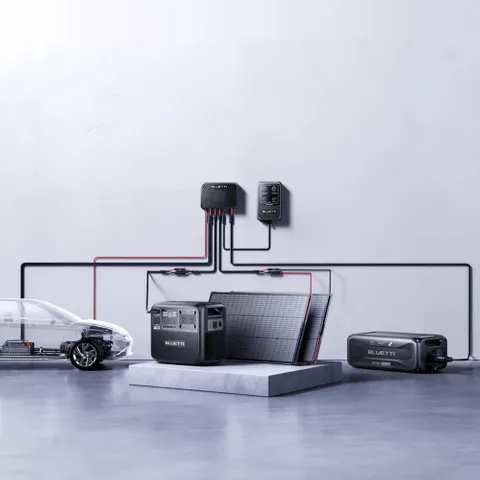
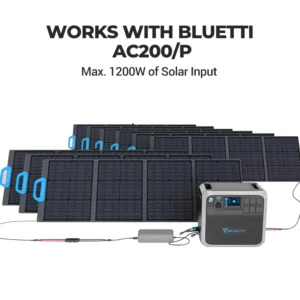
The BLUETTI Charger 2 solves this by connecting directly to your vehicle’s alternator (via proper wiring) and delivering up to 800 W of clean DC charging while the engine runs. Add a 600 W solar input on the same unit, and you can charge from both sources simultaneously up to 1,200 W combined. That drops your full recharge time from 20+ hours to about 2 hours.
For anyone building a serious mobile power system, this isn’t a nice-to-have accessory. It’s the missing piece that turns “I have a power station in my van” into “I have a functional off-grid electrical system in my van.”
The 1,200 W combined power breakdown
The Charger 2’s total 1,200 W capacity splits across two independent input sources:
| Input Source | Max Power | Voltage Range |
|---|---|---|
| Alternator (ALT port) | 800 W | 12.8 V – 25.6 V vehicle systems |
| Solar (PV port) | 600 W | 13 V – 50 V (MPPT) |
| Combined maximum | 1,200 W | — |
Practical implications:
- Driving in sunshine: both sources feed simultaneously, hitting the 1,200 W cap
- Driving at night or in shade: alternator alone at up to 800 W
- Parked in sunshine: solar alone at up to 600 W
- Parked at night: no charging (which is correct — you don’t want to drain the starter battery)
The PV input is MPPT-regulated meaning it optimises panel output regardless of shading conditions or cloud cover, extracting maximum available solar energy at any moment.
Simultaneous alternator + solar the killer feature
Most vehicle DC-DC chargers force you to choose: alternator OR solar, not both. The Charger 2’s dual-input architecture lets both sources feed simultaneously no switching, no unplugging, no manual reconfiguration.
Real-world benefit: on a long drive across the Central Plateau, your solar panels contribute 400-600 W while the alternator adds 700-800 W. Your power station reaches full charge in an hour instead of two and you arrive at camp with battery to spare for a multi-day stay.
Reverse charging the “emergency jumpstart” feature
Buried in the technical specs is one of the Charger 2’s most practical capabilities: reverse charging at up to 100 W. This means your BLUETTI power station can charge your vehicle’s starter battery when needed.
Real-world scenario: you left your headlights on overnight in a remote campsite. Starter battery is flat. Instead of hunting for jumper cables and a friendly neighbour, the Charger 2 automatically routes power from your BLUETTI back to the vehicle’s starter battery. Give it 30 minutes and you have enough charge to start the engine.
This is a genuine “get you home” safety feature that turns your power station into emergency roadside assistance no separate jump pack needed.
Bidirectional BAT port expandable off-grid capacity
The Charger 2’s BAT port is bidirectional at up to 1,000 W — meaning it can either:
- Charge an auxiliary battery bank from the alternator/solar inputs (extending your usable capacity beyond the power station)
- Discharge from an aux battery bank into the Charger 2’s outputs (running loads from a separate battery when the power station isn’t connected)
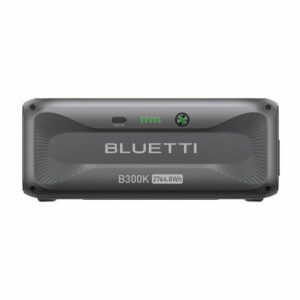
Compatible with BLUETTI’s B300K, B500K, B230, and B300 expansion batteries, or third-party auxiliary battery banks with appropriate configuration.
For serious off-grid van/RV setups, this bidirectional port genuinely changes what’s possible you can build a modular battery bank that scales as your needs grow.
The DC Hub Panel Port for extended DC distribution
The Charger 2 includes a 48 V DC Panel Port specifically designed to connect to the BLUETTI Hub D1 Power Hub. Adding the Hub D1 gives you:
- 9 additional DC output ports (USB-A × 2, USB-C PD × 2, cigarette lighter/DC5521 × 2, Anderson 50 A × 1)
- 12 V and 24 V smart voltage switching via app
- Total DC output up to 600 W across the Hub D1’s ports
Charger 2 + Hub D1 + BLUETTI power station = a complete van/RV/marine DC ecosystem. The Charger 2 handles all charging inputs (alternator + solar); the Hub D1 handles all DC output distribution; the power station stores the energy.
Without the Hub D1 connected, the DC Panel Port on the Charger 2 is inactive you still get all core alternator/solar charging capability, just no extended DC output ports.
Compatibility read this before ordering
Confirmed compatible power stations:
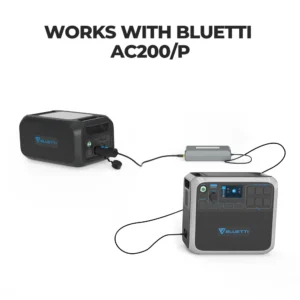
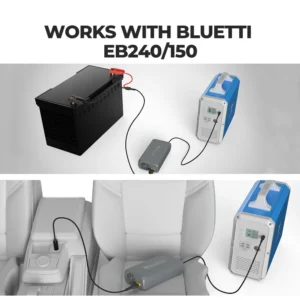
- ✅ All BLUETTI models — Apex 300, AC500, AC300, AC240, AC200MAX, AC200L, AC200P, AC180, AC70, AC60, and legacy models via appropriate cables
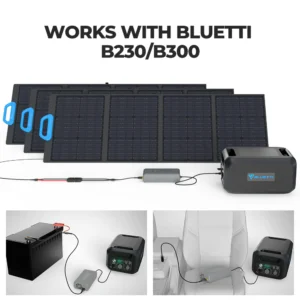
- ✅ BLUETTI expansion batteries — B300K, B500K, B230, B300
- ✅ 95% of third-party power stations — Jackery, EcoFlow, Anker, Bluetti competitors, plus most modern portable power stations
Verify before ordering:
- Check your specific power station’s DC input rating and connector type
- Third-party units may require an adapter cable (not included)
- Some older/off-brand power stations may not support the Charger 2’s full 1,200 W rate
Not designed for:
- Whole-home ESS units (EP500 Pro, EP800, EP900) these have their own charging systems
- Anything requiring AC input (this is a DC-only device)
Smart features via BLUETTI app
The Charger 2 connects to your phone via Bluetooth and Wi-Fi (dual connectivity) and integrates with the BLUETTI app for:
- Real-time monitoring — see current draw from alternator, solar, and going to power station simultaneously
- Charging rate adjustment — set custom limits (useful for older diesel engines where full 800 W alternator draw might be too much)
- Silent charging mode — caps input at 250-300 W for reduced fan noise and alternator load
- Priority charging — configure whether solar or alternator takes precedence when both available
- Error alerts — overvoltage, undervoltage, overcurrent, thermal shutdown warnings
- Firmware updates — periodic improvements over the air
For anyone running a mobile setup where power management actually matters, the app-based control is genuinely useful not just a marketing feature.
Full specifications
| Attribute | Detail |
|---|---|
| Product | BLUETTI Charger 2 Alternator & Solar Dual DC Charger |
| OUTPUT | |
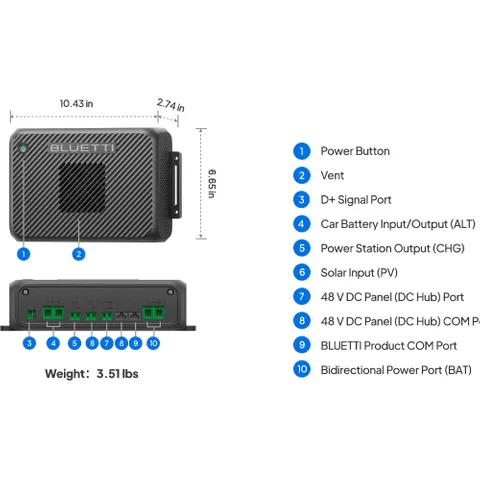
| CHG Port (Power Station Charging) | 12 V–56 V · 24 A · 1,200 W Max |
| DC Panel Port (48 V DC, for Hub D1) | 40–58.5 V · 2.5 A · Bypass 600 W Max |
| BAT Port (Aux Battery I/O, bidirectional) | 19.2 V–52 A · 25.6 V–39 A · 51.2 V–19.5 A · 1,000 W Max |
| Reverse Charging (to starter battery) | 100 W · 50/60 Hz |
| INPUT | |
| PV Input (Solar, MPPT) | 13 V–50 V · 20 A · 600 W Max |
| ALT Port (Alternator, bidirectional) | 12.8 V–62.5 A · 25.6 V–31.3 A · 800 W Max |
| GENERAL | |
| Compatibility | All BLUETTI + 95% of third-party portable power stations |
| Safety protections | Short circuit, reverse polarity, overcurrent, over/under voltage |
| Internal fuse | 75 A |
| Operating temperature | -20 °C to 60 °C (power tapers above 40 °C) |
| Storage temperature | -20 °C to 60 °C |
| Protection grade | IP20 (indoor/protected mounting only) |
| Max noise level | 50 dB |
| Weight | 1.59 kg / 3.51 lbs |
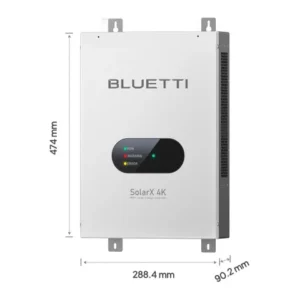
| Dimensions | 265 × 169 × 69.7 mm |
| Operating altitude | Below 2,000 m (6,561 ft) |
| Working humidity | 10 %–90 % |
| Connectivity | Bluetooth + Wi-Fi |
| Warranty | 2 years (extended from BLUETTI’s standard 12-month accessory warranty) |
What’s in the box
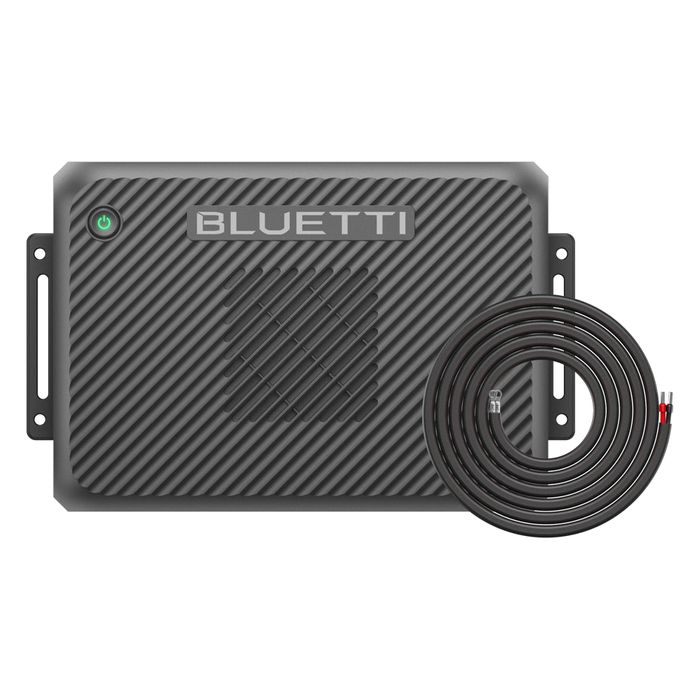
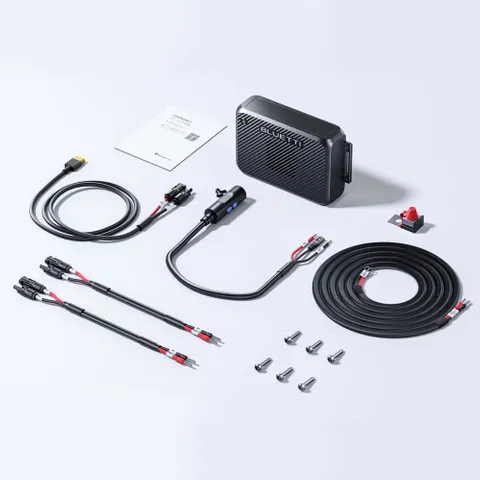
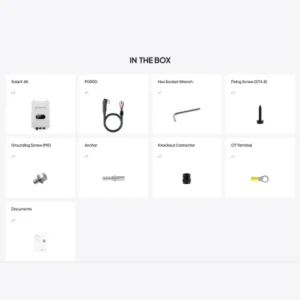
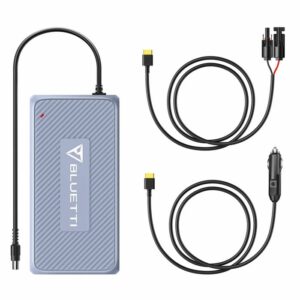
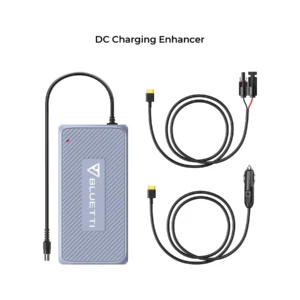
- 1 × BLUETTI Charger 2 unit
- Vehicle wiring harness (for alternator connection)
- Power station charging cable (aviation plug for BLUETTI)
- Quick-start guide
- Product care documentation
Not included (typically required):
- Solar panels (any MPPT-compatible 13-50 V panel array up to 600 W)
- Third-party power station adapter cables (varies by model)
- Vehicle-specific installation hardware (breakers, cable ties, mounting brackets often required for permanent install)
- BLUETTI Hub D1 (sold separately for extended DC output)
NZ use cases where this actually earns its keep
For NZ owners specifically, the Charger 2 is the right accessory in three main scenarios:
- Van conversion builds — Sprinter, Hiace, Transit conversions where you need serious mobile power without oversizing the electrical system. Charger 2 keeps your Apex 300 or AC200L full on any journey longer than an hour.
- Overlanding and remote adventures — extended trips into the South Island backcountry, Central Plateau, or Northland coast where you’re driving between camps and want to arrive with full batteries every time.
- Marine applications — powerboats and cruisers where you need to charge house batteries and portable power stations from the engine while underway, then supplement with solar at anchor.
- Weekend camping with heavy DC needs fridges, diesel heaters, lighting, and electronics on 3-4 day trips. Two hours of driving to and from camp = fully-recharged power station regardless of what you drew.
Installation notes
The Charger 2 is designed for semi-permanent vehicle installation not plug-and-play. Key considerations:
- Direct alternator wiring — requires proper cable routing from your vehicle’s alternator/starter battery to the Charger 2 mounting location
- Fuse protection — the Charger 2 has an internal 75 A fuse, but most installers add an inline fuse near the battery for redundancy
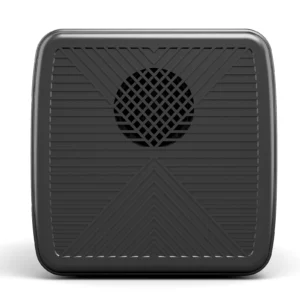
- Ventilation — the unit has a top-mounted cooling fan; needs airflow clearance
- IP20 protection — indoor or protected mounting only; not weatherproof
- Cable gauge — use appropriate wire gauge for the 800 W alternator draw (typically 6-8 AWG)
Recommended: professional auto-electrician installation, especially for permanent vehicle mounting or if you’re not confident with 12 V electrical work. NZ auto-electricians familiar with campervan conversions handle this daily.
Care and maintenance
- Keep ventilation clear — the top-mounted cooling fan needs airflow
- Inspect cable connections regularly — high-current connections benefit from periodic torque checks
- Update firmware when prompted — via BLUETTI app
- Don’t run above 40 °C ambient sustained — power will taper automatically to protect internals
- Store in dry location — IP20 means no exposure to rain or moisture





 No products in the cart.
Reviews
There are no reviews yet.